The Silver Screen and the Big Book: A Story of Machines and Dreams
Chapter I: The Architect of Shadows
The year was 1908, and Chicago was a city built on the rhythm of the rail and the smell of industrial ink. In a corner office of a sprawling complex on the city’s West Side, Alvah Curtis Roebuck sat surrounded by gears, glass lenses, and the heavy scent of machine oil. While the world knew him as the "Roebuck" in Sears, Roebuck and Co., Alvah was a man who preferred the silent company of mechanics to the loud roar of the boardroom.
He had recently stepped back from the massive retail operation to focus on his true passion: the Enterprise Optical Manufacturing Company. To Alvah, the future wasn’t just in selling watches or plows; it was in the "flicker." He spent his hours perfecting the Optigraph—a motion picture projector that he believed would change the world.
But Alvah was also a man of the "Big Book"—the Sears catalog. He knew that the catalog was more than a list of goods; it was a bridge. For millions of Americans, particularly those in the South and the burgeoning Black neighborhoods of the North, the catalog was the only place where their money was as good as anyone else’s. It was a silent silent partner in the quest for dignity.
"The machine doesn't care who turns the crank, Alvah," he whispered to himself, polishing a brass gear. "It only cares that the light is bright enough to cast a shadow."
Little did he know that his machines, and the credit systems he helped pioneer, were about to become the reproductive organs of a new American identity.
Chapter II: The Pullman Porter’s Vision
Across town, in a modest apartment in the Black metropolis of Bronzeville, William D. Foster—a man of sharp wit and even sharper suits—sat at his kitchen table. He was reading the Sears catalog, but he wasn't looking at suits or stoves. He was looking at the "Entertainment and Optical" section.
Foster was a press agent and a dreamer. He saw the way the world looked at his people through the lens of mainstream cinema—distorted, mocked, and relegated to the shadows of the background. He saw the "Great Train Robbery" and the burgeoning nickelodeons, and he saw a void.
"They won't tell our stories, so we must build the pens to write them," Foster told his friend, a young man who worked the rails.
But a motion picture camera was a king’s ransom. A professional setup—camera, developing tanks, and a projector—could cost hundreds of dollars, a fortune for a Black man in 1910. However, the "Big Book" offered something the local banks wouldn't: credit.
The Sears and Roebuck model allowed for installment payments. Five dollars here, ten dollars there. To the accountants in the Chicago office, the name "Foster" was just a ledger entry. They didn't see the color of his skin; they only saw the consistency of his payments.
With a signature and a deposit, Foster ordered the tools of a revolution. When the crates arrived, stamped with the Sears and Roebuck seal, they contained more than just wood and glass. They contained the ability to capture light.
In 1910, the Foster Photoplay Company was born. It was the first African American-owned film production company in the world. And it was built, piece by piece, out of the pages of a mail-order catalog.
Chapter III: The Optigraph in the Delta
The influence of the Chicago giants moved South. In the dusty towns of Mississippi and the vibrant streets of Atlanta, the "Race Film" movement began to stir like a sleeping giant.
It wasn't just about making films; it was about showing them. Segregated theaters often denied Black patrons or forced them into "buzzard roosts"—the cramped, hot balconies where the screen was a distorted trapezoid.
Enter the entrepreneurs. Men like Noble Johnson, a tall, charismatic actor who realized that if they couldn't get into the theaters, they would bring the theaters to the people.
Noble and his brother George founded the Lincoln Motion Picture Company in 1916. Their challenge was distribution. They needed projectors that were portable, durable, and, most importantly, affordable. Again, the Sears-Roebuck connection became the lifeline.
Alvah Roebuck’s Motiograph became the standard. African American entrepreneurs in the South would order these projectors on credit. They would set up "curtain theaters" in church basements, Masonic lodges, and even open fields. They would hang a white sheet between two trees, fire up the Motiograph, and for the first time, Black audiences saw themselves as heroes, doctors, lawyers, and lovers.
The light from the projector was a form of liberation. It washed away the caricatures of the minstrel shows and replaced them with the dignity of reality.
Chapter IV: The Salesman of the Plains
If William Foster was the spark and Noble Johnson was the heart, Oscar Micheaux was the fire.
Micheaux was a former Pullman porter and a homesteader in South Dakota. He was a man who understood the "Big Book" better than anyone. He had used it to buy the tools to break the sod on his farm. But Micheaux had a story to tell—a story of the Black pioneer, the "New Negro" who was rising from the ashes of Reconstruction.
In the late 1910s, Micheaux traveled the country with a suitcase full of scripts and a relentless spirit. He didn't have a studio. He had his wits. He would go to Black-owned businesses and convince them to invest in his films. Then, he would use that money to buy film stock and rent equipment—often the very equipment Alvah Roebuck had designed and sold through his various enterprises.
Micheaux’s films, like Within Our Gates, were raw and uncompromising. He tackled lynchings, the struggle for education, and the complexity of the Black experience.
He was a master of the "Sears Method." He knew that if you provided a quality product and a way for people to access it, you could bypass the gatekeepers. He didn't ask Hollywood for permission. He used the democratization of technology to build his own empire.
When Micheaux needed to develop his film, he utilized the growing network of independent labs that had sprung up to service the thousands of amateur photographers who had bought "Brownie" cameras from the Sears catalog. The infrastructure of a retail giant was unwittingly fueling the fires of a social revolution.
Chapter V: The Intersection of Two Worlds
One afternoon in 1922, Alvah Roebuck was walking through the exhibition floor of an early cinema trade show in Chicago. He was an older man now, respected as a pioneer of the industry. As he passed a small booth, he stopped.
On the wall was a poster for The Homesteader by Oscar Micheaux. Behind the table stood a young Black man, adjusting the lens on a Motiograph projector—Alvah’s own design.
Alvah approached the man. "How does she run?" he asked, nodding toward the machine.
The young man looked up, not recognizing the man whose name was on the building across town. "Runs like a dream, sir. We’ve taken this one through three states this month. She’s seen more of the country than a circuit rider."
"And the picture?" Alvah asked. "Is it clear?"
"Clear enough to change a man's mind," the youth replied. "When the folks in the Delta see a man who looks like them owning a farm on that screen... well, they don't look at the dirt the same way the next morning."
Alvah Roebuck stood in silence for a moment. He had spent his life thinking about gears, shutter speeds, and profit margins. He had thought of his machines as tools for entertainment. But looking at the worn brass of the projector and the pride in the young man's eyes, he realized the machine was a mirror.
He didn't claim credit for their stories. He knew he was just the man who sold the glass. But he felt a quiet sense of purpose knowing that the "Big Book" had done more than sell shoes—it had sold the means of self-expression.
Chapter VI: The Sound of Progress
As the 1920s roared on, the industry changed. Sound was coming. The independent "Race Film" companies faced new challenges as the cost of technology skyrocketed. The "Big Book" could provide a camera, but it couldn't provide a sound stage.
Yet, the foundation had been laid. The cycle had been established: Access to technology + Credit = Opportunity.
William D. Foster had proved the market existed. Noble Johnson had proved the dignity of the image. Oscar Micheaux had proved the power of the narrative.
And behind them all stood the silent infrastructure of the mail-order giants. By providing a system where a person's creditworthiness was determined by their character and their payments rather than their race, Sears and Roebuck had inadvertently funded the first Black media revolution.
The credit programs allowed a community that had been systematically stripped of its wealth to reacquire the tools of production. It was a loophole in the wall of segregation—a way to buy the future on the installment plan.
Chapter VII: The Legacy of Light
Decades later, the era of the Race Film would be remembered as a golden age of independent cinema. The films of Micheaux and Foster would be preserved in the Library of Congress, studied by scholars as the birth of a unique American voice.
Alvah Roebuck passed away in 1948. By then, the world of cinema was a multi-billion dollar industry. His role was often simplified to that of a businessman, a partner to Richard Sears. But in the quiet corners of film history, his name remained etched on the baseplates of the projectors that had served as the pulpits for a generation of Black storytellers.
The story of early Black cinema is often told as a struggle against the odds—and it was. But it is also a story of entrepreneurship. It is the story of how a catalog in a rural mailbox could be a portal to a different world. It is the story of how a camera, bought for five dollars a month, could capture the soul of a people.
Epilogue: The Eternal Flicker
In a modern film school in New York, a student leans over a digital editing suite. She is working on a documentary about her great-grandfather, a man who once owned a small "colored-only" theater in North Carolina.
In her research, she finds an old receipt, yellowed and brittle. It is from 1919.
Item: One (1) Optigraph Projector, Model No. 4. Source: Sears, Roebuck and Co., Chicago, IL. Terms: $10.00 down, $2.00 per month.
She smiles. She realizes that her career, her vision, and her ability to tell her story started with that receipt. It started with a man named Alvah who loved gears, and a man named William who loved stories, and a "Big Book" that told them both that anything was possible if you were willing to pay for it, one month at a time.
The light of the projector never truly goes out. It just changes form. From the nitrate film of 1910 to the digital sensors of today, the mission remains the same: to cast a shadow that looks like the truth.
And in that silver flicker, the ghosts of Roebuck, Foster, and Micheaux still dance—a testament to the power of credit, cameras, and the unwavering determination to be seen.
Historical Note
While Alvah Curtis Roebuck and Richard Warren Sears were white, their business model was revolutionary for the Black community. In an era of "Jim Crow" laws, the Sears catalog provided a "store in a book" where African Americans could shop without the humiliation of being ignored or overcharged by local white merchants.
The access to high-quality camera equipment and projectors through these catalogs, combined with the company’s willingness to extend credit to customers regardless of race (as long as they paid), provided the technical foundation for the first generation of Black filmmakers.
William D. Foster, Noble Johnson, and Oscar Micheaux were the true pioneers who took these tools and built an industry that challenged the status quo, proving that the lens of a camera is one of the most powerful weapons in the fight for equality. Their legacy lives on in every Black filmmaker who continues to tell stories that refuse to be relegated to the shadows.
SDC NEWS ONE | When Carmen Changed the Radio Airwaves of One Local Station-
Detroit's Radio Revolution: How Black-Owned Broadcasting Changed the Sound of the Motor City
SDC News One Educational Feature
Long before Detroit became internationally known as the home of Motown, the city was already experiencing a cultural revolution through its radio airwaves. At the center of that transformation were pioneering Black broadcasters who recognized an audience that much of corporate America had ignored.
One of the most important milestones in Detroit broadcasting history arrived in 1956 with the founding of WCHB-AM, widely recognized as the first Black-owned, Black-programmed radio station built from the ground up in the Detroit metropolitan area. The station was established by two Black dentists, Dr. Haley Bell and Dr. Wendell Cox, who saw an opportunity to serve Detroit's growing African American community with programming that reflected its culture, interests, and music.
Their achievement was remarkable considering the era. During the 1950s, segregation and discriminatory business practices limited opportunities for Black ownership across many industries, including media. Yet Bell and Cox successfully built a station that would become an influential voice in Detroit and a model for Black-owned broadcasting nationwide.
Why Stations Changed Formats
The rise of Black-oriented radio was often tied to a simple economic reality: listeners wanted programming that reflected their lives.
Throughout the 1940s and 1950s, numerous struggling AM stations across America faced declining audiences and financial difficulties. Many station owners focused almost exclusively on white audiences while overlooking large and rapidly growing Black communities.
Some broadcasters eventually realized they were ignoring a substantial market. When stations began introducing rhythm and blues, jazz, gospel, and later soul music, ratings often increased dramatically.
A famous example was WDIA in Memphis, which became one of America's most successful radio stations after shifting to programming aimed primarily at Black listeners. Similar lessons would influence broadcasters throughout the country, including in Detroit.
The decision was not always driven by social progress. In many cases, it was driven by survival. Stations discovered that serving Black audiences was not only culturally important but also financially profitable.
The Battle Between Corporate Control and Local Culture
A recurring theme in broadcasting history involved tensions between corporate management and local communities.
Many station owners preferred relationships with major national record labels such as RCA, Columbia, and Decca. These companies offered established distribution networks and predictable business arrangements. Independent local labels, by contrast, were often viewed as risky and difficult to manage.
This dynamic created conflicts that became legendary in radio history.
Station executives frequently imposed strict rules limiting or even banning local recordings. Their concerns included maintaining centralized control over playlists and avoiding accusations of "payola," a practice in which disc jockeys accepted money or gifts in exchange for playing specific records.
By the late 1950s, payola scandals rocked the music industry and led to investigations that damaged careers and changed broadcasting regulations. Many owners responded by tightening oversight of what could be played on the air.
Yet local DJs often knew something corporate executives did not: listeners wanted to hear the sounds emerging from their own neighborhoods.
Detroit's Independent Music Explosion
Detroit was uniquely positioned for this conflict.
The city was overflowing with musical talent. Independent labels, neighborhood recording studios, church choirs, jazz ensembles, and aspiring singers were producing music at an astonishing rate. Before Motown became a global powerhouse, local artists relied heavily on radio exposure to build audiences.
For many broadcasters, playing local records represented a gamble. For DJs connected to the community, it represented an opportunity.
Across America, radio personalities became cultural gatekeepers who could turn an unknown local performer into a regional sensation simply by giving a song airtime.
In Detroit, those decisions helped lay the groundwork for what would become one of the most influential music cities in history.
A Story That Mirrors Reality
The dramatic image of a powerful media mogul enforcing a rigid "no local music" policy captures a very real struggle that existed throughout broadcasting's golden age.
On one side stood executives concerned with corporate control, business relationships, and regulatory risks.
On the other stood DJs, programmers, musicians, and listeners who believed local voices deserved to be heard.
That conflict fueled innovation and helped transform American radio. It also reflected broader social changes occurring throughout the nation as communities demanded greater representation in media and public life.
The success of stations such as WCHB demonstrated that Black audiences were not a niche market but a major force shaping American culture. Their influence extended beyond radio, helping launch artists, support local businesses, and create a platform for community leadership.
Today, the legacy of Detroit's pioneering Black broadcasters remains an important chapter in both media history and the story of the city's musical evolution. Their willingness to challenge industry assumptions helped ensure that the sounds of Detroit would eventually be heard around the world.
By SDC News One
The air at the Detroit Michigan County Fair was thick with the scent of fried dough and the heavy, humid heat of 1959, but near the WBLD-AM broadcast booth, the atmosphere felt electric for a different reason. It was 12:01PM as Lee Rogers’ velvet voice smoothed out over the speakers, echoing across the fairgrounds with the opening bars of "Walk On By," the crowd didn't just listen—they paused. It was the sound of a new era. Ernie Durham was talking into the record's lead-in that WBLD-AM was now all music all the time, and from there, the first black all music radio station was on the air.
The red neon sign atop the Cadillac Tower hummed with fifty thousand watts of pure, unfiltered authority. WBLD-AM, Detroit. To the millions of listeners tuning in across the Midwest, it wasn’t just a radio station; it was "The Voice of Elegance."
Inside Studio A, the air was thick with the scent of ozone from the massive vacuum tubes, grooming wax, and the expensive Turkish tobacco smoked by Arthur "Artie" Vance. Artie was WBLD’s crown prince of the midnight shift.
Artie adjusted his heavy, chrome RCA microphone and looked through the double-paned glass at his engineer, Leo. Leo gave him the cue—three fingers, two, one.
"It’s twelve-fifteen in the Motor City," Artie’s voice slid over the airwaves like warm syrup. "You’re locked into WBLD, where the music is always golden and the night is always young. Up next, we’ve got the sweater-clad sultan of smooth himself, Mr. Perry Como, telling us all about 'Catch a Falling Star.' Keep it right here on the powerhouse."
With a practiced flick of his wrist, Artie potted down the microphone and watched the heavy arm of the turntable drop onto the pristine vinyl. The opening chimes of Como’s hit floated through the studio monitors.
WBLD was a juggernaut. Its playlist was a fortress of sophistication. If you wanted to hear Doris Day’s sunny optimism, Peggy Lee’s sultry, feverish whispers, the velvet-coated charm of Nat King Cole, or the ring-a-ding-ding bravado of Frank Sinatra, WBLD was your cathedral
But there was a rule at WBLD. A golden, unbreakable, iron-clad rule handed down directly from the station’s owner, a stern, old-money broadcasting mogul named Harvey Stone.
No local music.
None. Not the gritty blues coming out of the barrooms on Hastings Street. Not the raw, stomping rockabilly cut in makeshift basement studios in Dearborn. And certainly not the fast, rhythmic, hand-clapping soul that a young man named Berry Gordy was just beginning to record in a house on West Grand Boulevard.
To Harvey Stone, Detroit was a city of grease, steel, and assembly lines. Music, however, was a product of high society. Music belonged to the major labels in New York and Los Angeles—Columbia, Capitol, Decca, Mercury.
"Detroit makes cars, Artie," Stone had told him more than once, tapping a manicured finger on Artie’s console. "We do not make art. We play the Hit Parade. We play the stars. If it didn’t come out of a skyscraper in Manhattan, it doesn’t cross my airwaves."
And the brightest star in WBLD’s galaxy was Diana Washington.
Diana was a force of nature. Signed to a powerhouse major label, she was a superstar whose voice possessed a regal, devastating beauty. She could sing jazz, pop, blues, and Broadway, and make them all sound like high-class royalty. WBLD gave Diana Washington special treatment. Her records didn't just play; they were ushered onto the air with the reverence of a papal visit. She was the station’s darling, the ultimate proof that WBLD stood for the highest echelon of American music.
The studio door clicked open. Leo slipped in, carrying a fresh stack of promotional shellacs and a steaming mug of black coffee.
"The front desk just sent this up," Leo said, dropping a brown cardboard sleeve onto the desk. "Some kid in a leather jacket tried to hand-deliver it. Said he recorded it in his garage over on the East Side. Begged us to give it a spin."
Artie picked up the sleeve. There was no professional label, just a hand-written title on a piece of white tape: “Motor City Groove.”
Artie sighed, feeling a familiar, dull ache in his chest. He looked out the soundproof window, down at the wet, rain-slicked streets of Detroit. The city was vibrating. You could feel it in the soles of your shoes—a new kind of energy, a restless, driving beat that didn't care about the Hit Parade. The kids in the high schools were hummimg it. The workers on the midnight shift at the Ford Rouge plant were craving it.
But WBLD was a fortress, sealed off from the city it broadcasted to.
"You know the rules, Leo," Artie said, tossing the cardboard sleeve into the green metal wastebasket by his desk. It landed with a hollow thud. "Harvey catches us playing a local vanity press, we’re both spinning records in Toledo by Monday."
"Yeah," Leo muttered, looking a bit disappointed. "I know. Just... the kid looked so hungry."
"This is WBLD, Leo. We don't sell hunger. We sell dreams."
Artie cleared his throat, pulling the next record from the executive-approved stack. It was the brand-new single from Diana Washington, fresh off the press from Mercury Records in New York. The label was a beautiful, glossy red, embossed with gold lettering. It practically screamed prestige.
As Perry Como faded out, Artie hit his microphone switch.
"That was the incomparable Perry Como," Artie said, his voice wrapping around the city like a heavy wool coat. "And now, listeners, it’s time for the crown jewel of our broadcast day. The incomparable, the breathtaking, Miss Diana Washington. Fresh off her sold-out run at the Copacabana, she brings us her latest masterpiece, 'Stars Fell on Michigan.' Lay back, Detroit, and let a real star show you how it's done."
Artie dropped the needle.
Diana Washington’s voice soared through the studio monitors—a masterclass in control, pitch, and heartbreaking glamour. It was flawless. It was magnificent. It was exactly what the major labels paid thousands of dollars to produce.
Artie sat back in his vinyl chair, lit a cigarette, and watched the smoke drift toward the acoustic tiling on the ceiling.
Through the glass, the phone lines were lighting up like a Christmas tree. Callers from Grosse Pointe, from Bloomfield Hills, Gaylord, even from across the river in Windsor, ringing in to praise the song. WBLD was giving them the polished, perfect fantasy they wanted.
Outside, the rain kept falling on the grit and iron of Detroit. A city pulsing with a raw, electric sound of its own, waiting in the dark, completely ignored by the fifty-thousand-watt tower that rose above it. But inside Studio A, under the warm glow of the vacuum tubes, Frank Sinatra was up next, the Hit Parade marched on, and the gates of the fortress remained closed.
High above the booth, peering through the glass with a sharp, satisfied smile, stood Carmen C. Murphy. She smoothed the lapel of her tailored suit, her eyes tracking the growing line of local musicians clutching their 45-rpm records like gold bars. She had built the House of Beauty from cosmetics to a gospel empire, and now, by providing the backbone for manufacturing and distribution, she was the silent architect of this new sonic landscape.
"It’s a revolution, Carmen," a voice rumbled behind her.
She turned to see Berry Gordy, Jr. leaning against the doorframe. He looked sharp, but his eyes were restless, constantly scanning the equipment and the crowd. Beside him stood Michael Alonzo Hanks, the President of D-Town Records. While Gordy’s Motown was aiming for a polished, universal pop appeal, Hanks’ D-Town records carried the gritty, soulful heartbeat of Detroit’s streets.
"It’s more than a revolution, Berry," Carmen replied, gesturing to the scene below. "It’s ownership. For the first time, we aren't just making the music; we’re owning the air it travels on."
Down on the floor, Ernie Durham—known to the streets as 'Frantic Ernie'—was a whirlwind of motion. He was sliding faders and cueing up the next track with a frantic energy that earned him his nickname. Jack Ellis stood beside him, acting as the gatekeeper.
"Make way! Make way for the future!" Jack shouted, laughing as he cleared a path for Michael Hanks, who was carrying a fresh batch of D-Town pressings.
Ernie leaned into the microphone, his voice crackling with charismatic heat. "You’re listening to WBLD-AM, the heartbeat of the Motor City! We just heard Lee Rogers taking us to school, and coming up next, we’ve got a little something from the D-Town stables. If you’re at the fair, get down here! If you’ve got a song in your heart and a record in your hand, Detroit wants to hear it!"
Michael Hanks stepped up to the booth, sliding a record across the console to Ernie. "This one’s going to shake the windows in Highland Park, Ernie. Play it loud."
Berry Gordy watched from the balcony, a competitive glint in his eye. He knew that while Carmen Murphy’s HOB Records was currently manufacturing and distributing their hits, the day was coming when the Detroit sound would outgrow even this station.
"You see that, Carmen?" Berry asked, pointing to a group of teenagers dancing near a popcorn stand to the rhythm of the radio. "They aren't just listening to a song. They’re listening to themselves. My Motown groups... they’re going to be the ones those kids see when they close their eyes."
Carmen nodded, her expression regal. She knew the power she held. Without her HOB distribution, those records would be sitting in boxes in a basement. "Competition is healthy, Berry. But remember, the House of Beauty started with Gospel. We provided the soul. You and Michael are providing the rhythm. Together, we’re giving this city a voice it can never lose."
As the sun began to dip behind the Detroit skyline, the fairgrounds transformed. The neon lights of the Ferris wheel flickered on, but the brightest glow came from the small, glass-walled booth where Jack Ellis and Ernie Durham worked.
The Gospel Hour may have been reduced to make room for the surge of commercials and new hits, but its spirit remained. Every blues lick, every soul shout, and every pop hook played that day was a testament to the foundation Carmen Murphy had laid.
The transformation of WBLD-AM wasn't just a change in a radio format; it was the birth of a cultural superpower. As a young Mary Wells or a member of the Miracles might have walked through the fair crowd that day, they would have heard their future echoing from every transistor radio in sight. Detroit was no longer just the town that built the cars the world drove; it was now the town that provided the soundtrack for the journey.
=====================================
This is Factual/Fictional documentory the real radio stations and people this story is based on below.
The story you are describing is a classic piece of radio folklore and creative fiction, rather than real Detroit broadcasting history.
In reality, there was never a commercial AM station called "WBLD" in Detroit, and its historical counterpart—the actual first Black-owned, Black-programmed station built from the ground up in the Detroit area—was WCHB-AM, founded in 1956 by two Black dentists, Dr. Haley Bell and Dr. Wendell Cox. Furthermore, the real-life broadcasting executive named Harvey Stone was actually a West Coast radio pioneer who created the famous "Quiet Storm" format at KBLX in Berkeley, California. [1, 2, 3, 4, 5]
However, within the fictional or dramatized premise you are referencing, the twist of the "no local music" rule creates a massive narrative conflict. Here is the breakdown of how that scenario plays out and why it is historically ironic:
The Real-World Conflict Behind the Premise
If a Detroit station in the mid-to-late 20th century switched to an all-Black music format but strictly banned local music, it would mean the station could not play Motown Records.
Founded by Berry Gordy Jr. in Detroit in 1959, Motown was the absolute definitive sound of Black popular music during the golden era of AM radio. Banning local artists would mean a Black music station in Detroit could not play: [5]
In the world of broadcasting, a dramatic format change to Black appeal programming was almost always driven by failing ratings and financial desperation. In the 1940s and 1950s, many struggling white-owned AM stations (like the legendary WDIA in Memphis) realized they were ignoring a massive, economically viable Black demographic. To save the station from bankruptcy, owners would reluctantly hand the airwaves over to R&B, jazz, and soul music, which instantly captured high ratings and lucrative advertising dollars. [6, 7, 8, 9]
The Drama of Harvey Stone's Rule
The "iron-clad rule" handed down by a stern, old-money mogul like Harvey Stone perfectly sets up a classic David-vs-Goliath story. Old-money media moguls of that era were often deeply out of touch with youth culture, local community movements, and the shift toward independent record labels. A "no local music" rule was typically enforced because:
Corporate Control: Moguls preferred syndicated national feeds or major corporate record labels (like RCA or Columbia) over independent local distributors.
Anti-Payola Bias: Station owners feared "payola" (DJs taking bribes from local producers to play their records), so they banned local music entirely to keep clean books. [10]
In a narrative setting, this "unbreakable" rule forces the station's DJs and program directors to innovate, sneak local hits onto the airwaves under fake artist names, or directly rebel against corporate management to give the local community what it actually wants to hear.
If you are looking to explore this scenario further, let me know if you want to flesh out a script or story based on these characters, or if you want to dive deeper into the true history of Detroit's real pioneer Black radio stations like WCHB and WJLB! [1, 11]
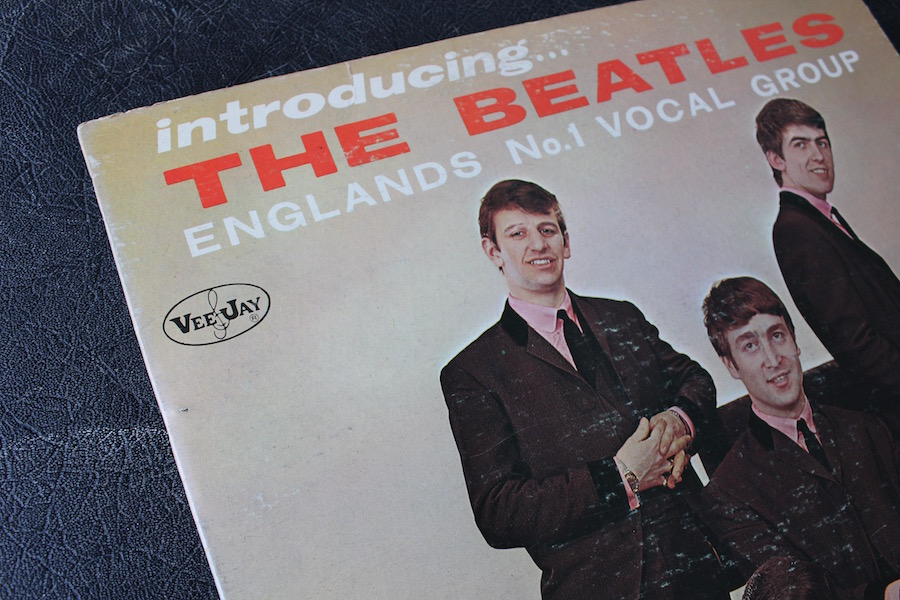
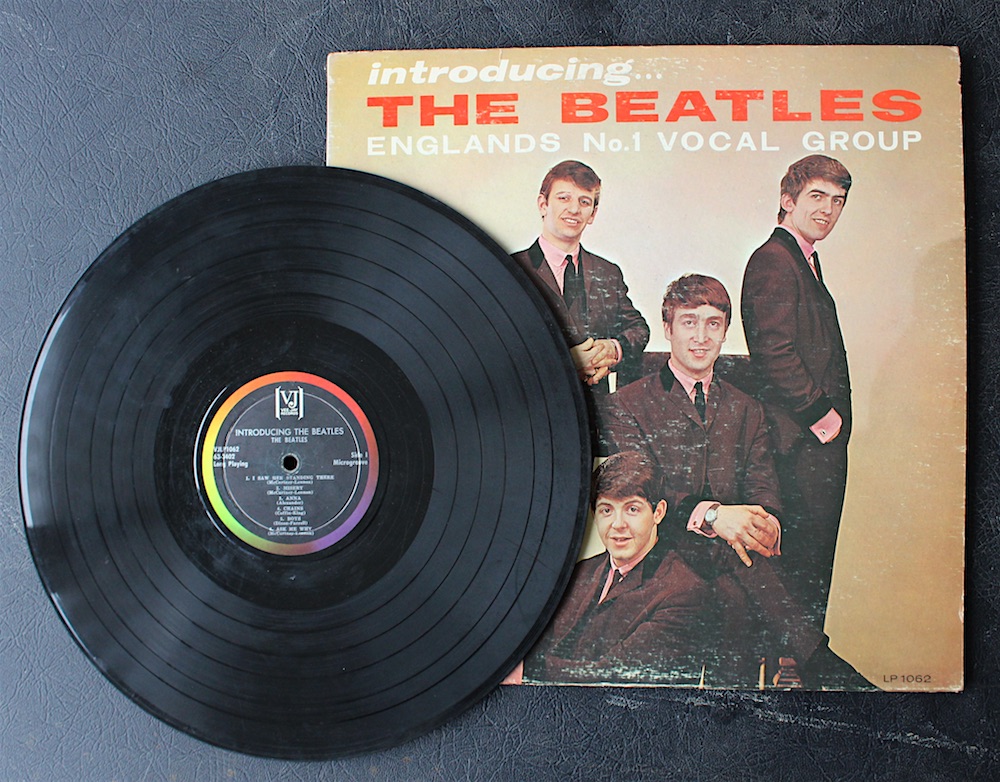
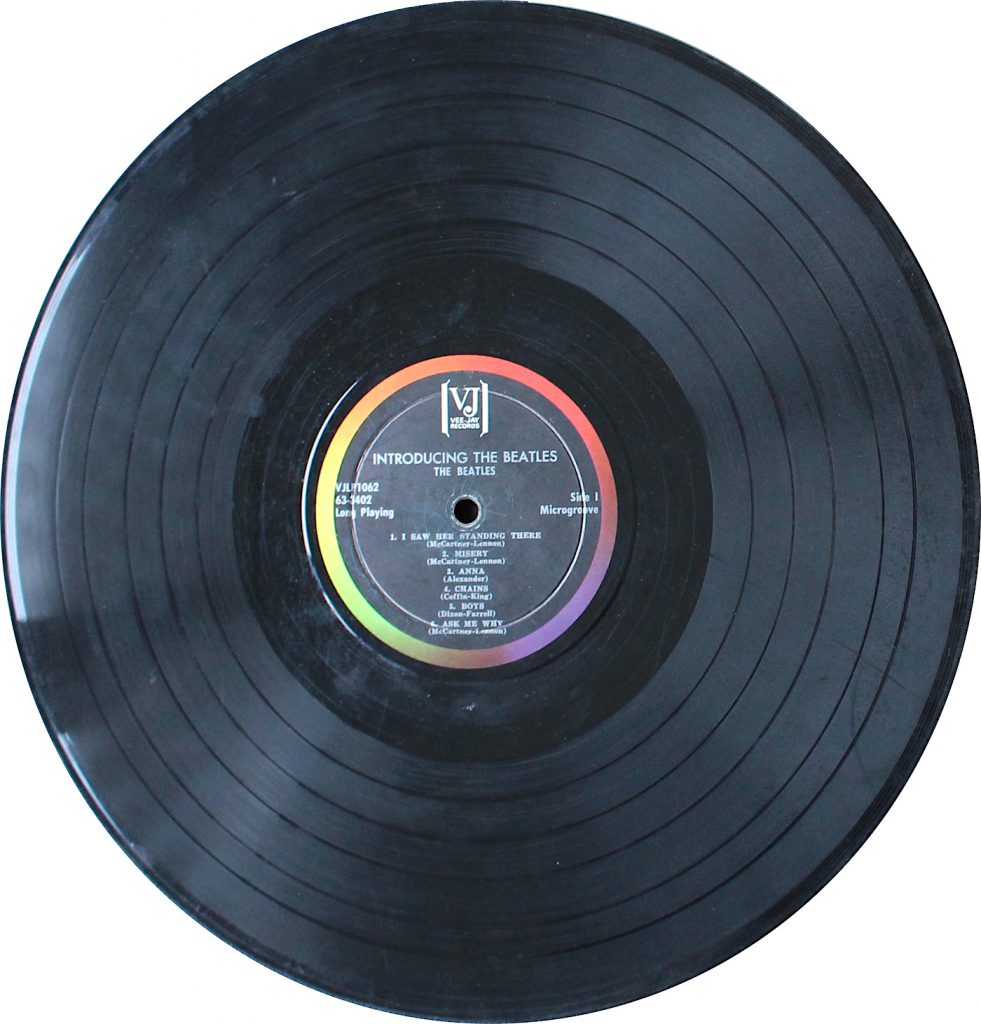
To a serious record collector, the copy of Introducing… The Beatles in our museum collection probably wouldn’t appear all that special. It is, after all, a non-mint example of the second and considerably more common version of the album, released in bulk on Chicago’s Vee-Jay label after some legal wranglings with Capitol Records in 1964 (the tracks “Love Me Do” and “P.S. I Love You” were scrapped from these later pressings due to a restraining order). To the teenage girl who actually purchased, played, cherished, and sang along to this record when it came out, however, its value remains unquantifiable. . . . And that’s a fact I have on firsthand authority from the girl herself, who later became my mother. Thanks for the donation, Mom!
Back in ’64, of course, young fans of the Liverpool lads didn’t care much about the business end of Beatlemania—labels and contract disputes, etc. They just wanted anything with John, Paul, George & Ringo on it. So, while Vee-Jay’s Introducing the Beatles has the distinction of being the first long-player Beatle album released in the U.S. (January 10, 1964), Capitol’s Meet the Beatles—released just two weeks later—immediately joined it at the top of the charts. Together, these records dropped the needle on a seismic pivot point in American culture, coming less than two months after the assassination of John F. Kennedy and one month before the Beatles themselves landed at the newly renamed JFK Airport in New York—recharging the batteries of a dazed populous in a bleak winter.
Inside the unlikely eye of this transcendental storm, meanwhile, was a small family business in Chicago—a fiercely independent record label co-owned and operated by a pioneering African-American woman, Vivian Carter, and driven by a diverse team of producers, promoters, and performers as talented as any in the country. This was Vee-Jay.
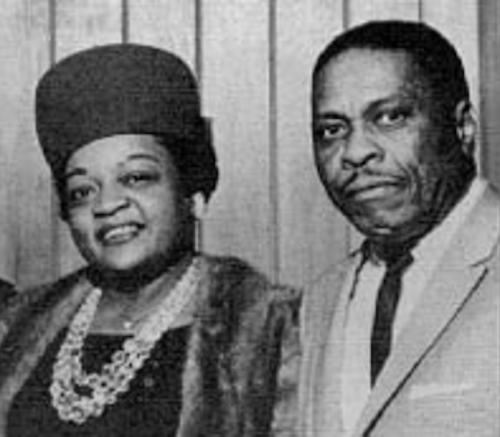
[from left: Vee-Jay co-owners Vivian Carter-Bracken and James Bracken, and company president Ewart Abner, 1961, from Ebony magazine]
Now I’ll be the first to admit, using Introducing the Beatles as the representative artifact of Vee-Jay Records in the Made In Chicago Museum is simultaneously the logical choice (it was a platinum seller and their greatest dent in the zeitgeist) and a mildly insulting one, considering their larger body of work.
In the half-century since Vee-Jay’s demise, historians have inadvertently—but continuously—simplified the label’s musical legacy into a sort of frustrating “also ran” category. In a Chicago context, its contributions to blues and R&B are overshadowed by its Michigan Avenue neighbor, Chess Records. As a black-owned label, it’s eclipsed by Motown. Vivian Carter’s groundbreaking work as a female executive gets less ink than the similar efforts of her white contemporaries Estelle Axton (Stax) and Florence Greenberg (Scepter). And in the largest number of cases, Vee-Jay is merely reduced to a footnote in the oft-told saga of the Fab Four and their invasion of America.
To set the record straight (pun intended), Vee-Jay didn’t need the Beatles to achieve success. If anything, the Beatles went looking for Vee-Jay. And in terms of record companies with a track record (pun less intended) for recruiting, recording, and marketing elite-level talent in the 1950s and 1960s, Vee-Jay’s resume easily speaks for itself. . . . But we’ll reiterate a bit anyway.
I. Livin’ with Vivian
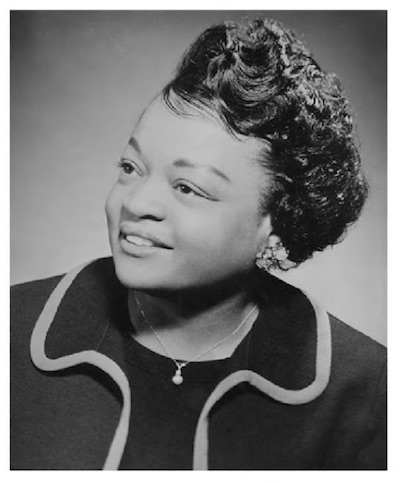
Vee-Jay Records was launched in 1953 as an offshoot of a Gary, Indiana record shop owned by the aforementioned Vivian Carter and her soon-to-be husband James Bracken. Vivian (1921-1989) was something of a local celebrity—a velvet-voiced charmer who hosted a popular radio show, “Livin’ with Vivian,” on Gary stations WGRY and WWCA. “I was lucky to be able to tell what the people liked because of my program,” she later told Ebony magazine.
For several years, Vivian learned all about the relationship between music and marketing. She could hear a new record at her shop and promote it on her show (which featured mostly gospel and a little rhythm & blues), or—in many cases—she’d get positive feedback about a song from her radio listeners, and use it as an impetus to try and stock the corresponding record at the store. The only snag was that many local acts simply didn’t have any recordings available outside of a demo. And so, the next logical step became crystal clear.
In their first foray into the record-making biz, Vivian and Jimmy spent $500 in 1953 cutting a couple singles for a teenage singing group, the Spaniels, who’d recently won a talent contest at Vivian’s old high school. Those tunes, which were actually released through Chicago’s Chance Records on the first go-round, were then played on Vivian’s radio show (not sure if self-payola is a thing) and soon found a wider audience across the Chicagoland area. The experiment was a success. Vee-Jay Records (as in “V” for Vivian and “J” for James) was a go.
Despite its Gary roots, Vee-Jay operated, right from the beginning, as a Chicago business. This was largely because its original A&R man, Vivian’s brother Calvin Carter, was based in Chicago and equipped with connections. In 1953 alone, Calvin set up Vee-Jay’s first rehearsal/audition space in a garage at 47th Street and King Drive; discovered and signed its first marquee blues act in Jimmy Reed (who had been working in the Union Stockyards); and established a regular studio use arrangement with the Universal Recording Corp., one of the largest independent studios in the country.
[Most of Vee-Jay’s records were cut in the studios of Chicago’s Universal Recording Corp, which moved into this massive building at 46 E. Walton Street in 1955. The building is seen as a storefront in 2010 on the right. It has since been rehabbed again to the point of being nearly unrecognizable.]
Vee-Jay also found a key partner in Chicago’s United Record Distributors, the first major black-owned music distribution company in the country, run by brothers George and Ernie Leaner (who later formed their own One-derful! label in 1962). It was at the United offices, at 2029 S. Michigan Avenue, just before Christmas in 1953, that Vivian Carter and Jimmy Bracken’s professional partnership became a more legally binding arrangement.
“Last week, December 16, while Ernie Leaner of United Record Distributors was very, very busy taking orders and helping his men pack off those Xmas record shipments, in walked Vivian Carter and Jimmy Bracken, partners in Vee Jay Records,”Cash Box magazine reported in its Jan 2, 1954 issue. “. . . ‘We’re looking for a preacher,’ Vivian casually mentioned to Ernie, after the usual affable greetings among these friends. Ernie’s ears pricked right up. His eyes lighted. But, looking out the window, with the snowy rain acomin’ down, Ernie said, ‘I know a preacher. He’s just down the street. Now you two stay here out of this bad weather,’ Ernie urged, ‘and I’ll go fetch him.’ So Ernie dashed down the street just as fast as he could go. And on the way bought a gorgeous bouquet for Vivian. Came back with the preacher and said, ‘Here they are, Reverend.’ So-o-o-o with Ernie Leaner and his secretary serving as the two necessary witnesses, Vivian Carter and Jimmy Bracken tied themselves together into the firmest kind of partnership by becoming Mr. and Mrs. And this happened right in the gay and festive Christmasy offices of United Record Distributors here in good, ole Chicago.”
Right around the same time—as a wedding gift you might say—the Spaniels scored Vee-Jay’s first national R&B hit with “Goodnite, Sweetheart, Goodnite” (covered to even greater success later by the McGuire Sisters). Vivian, Jimmy and Calvin now had a sense that they could legitimately compete on the big stage, even if it meant watching white artists inevitably butcher their tunes shortly thereafter.
II. Behind the Music
Over the next year or so, 1954 into 1955, Vee-Jay got its house band together, purchased its own downtown offices on “Record Row” at 2129 S. Michigan Avenue (Chess Records would move in across the street, at 2120 S. Michigan, in 1956), and started accumulating a bigger roster of talent. In ’55, a local doo-wop group called the El Dorados notched the label its first hit on the national pop charts, and behind the scenes, an accountant named Ewart Abner left the now defunct Chance Records to become the general manager of Vivian and Jimmy’s budding business.
“Vivian and Jimmy didn’t really know all that much about business things when it got into the real heavy paperwork,” former Vee-Jay saxophonist Red Holloway recalled to journalist Mike Callahan in a 1981 Goldmine article. “So since Abner had been doing that at Chance, they just made a deal with him and he went over there. Abner became pretty much the boss. Jimmy and Vivian still called the shots, because they owned the label, but when it came to the final details of making deals and stuff, that’s where Abner was the boss, because he knew more about it and had more insight into what was happening.”
A graduate of Englewood High School and Howard University, Ewart Abner (1923-1997) first broke into the industry working in a Chicago record pressing plant in the ‘40s. He was a small, skinny fellow—hardly intimidating—but he carried a different sort of weight; a confidence that comes with being the smartest guy in the room. After going back to school to get an accounting degree from Depaul, he helped establish the Chance label in 1950 (with Art Sheridan), working on sessions with doo-wop luminaries the Moonglows and Flamingos. Later in his career, Abner’s greatest fame would come as a manager and eventual president of Motown during much of its golden era (1967-1975), managing acts like the Supremes, Marvin Gaye, the Temptations, the Jackson 5, and Stevie Wonder (he’d remain Stevie’s personal business manager into the 1980s). It was during his time with Vee-Jay, though, that Abner really built his reputation, not only introducing the world to the “Chicago Soul” sound, but expanding the horizons of what a “black label” could do.
“Abner was the smartest guy I ever met in the record business, period,” claimed Bill Matheson, a lawyer who routinely negotiated with Abner while representing his client, R&B singer Jerry Butler. “No one came close. In fact, he was overqualified to be in the record business. . . . He apparently was a voracious reader, and could remember everything he read—something close to total recall. . . . He’d read something translated from Chinese just to find out what they were thinking. . . . He was a brilliant Renaissance guy.”
[Ewart Abner (dark suit) at a meeting of the American Record Manufacturers & Distributors Association with industry men William Shockett, Amos Heilicher, and Atlantic Records president Ahmet Ertegun. From Ebony magazine, 1961.]
Abner tended to impress a lot of people he met, lawyers or otherwise. During his time as the face of Vee-Jay, he became something of a pied piper for his peers in the industry, organizing the American Record Manufacturers and Distributors Association in 1958. He also knew that sustained success depended on breaking down the old walls between white and black music—be it in distribution, radio play, and even talent acquisition. Vee-Jay employed both black and white foot soldiers to promote their artists across the country, and those artists themselves began to include more mainstream white pop acts, as well (about 30% of the Vee-Jay roster by 1961).
“If we want to stay in business,” Abner told Ebony, “we’ve got to stop thinking of ourselves as just a Negro company.”
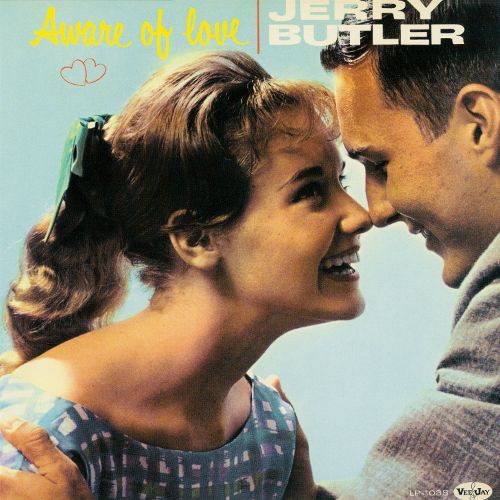
[Sometimes the Vee-Jay crossover strategy included putting some very vanilla looking white teens on the album cover of a black soul singer like Jerry Butler]
Abner, like a lot of ballsy intellectuals, was also a gambling man, and this wound up posing some serious problems for his employers down the road. In Vee-Jay’s formative years, though, Abner and Calvin Carter formed a truly dynamic duo. From soul and gospel to blues, jazz, and pop, they seemed to have a radar for star power and an instinct for fostering it. Abner handled the numbers, and Carter—a talented singer in his own right—held the auditions, ran the recording studio, and pinpointed the hooks.
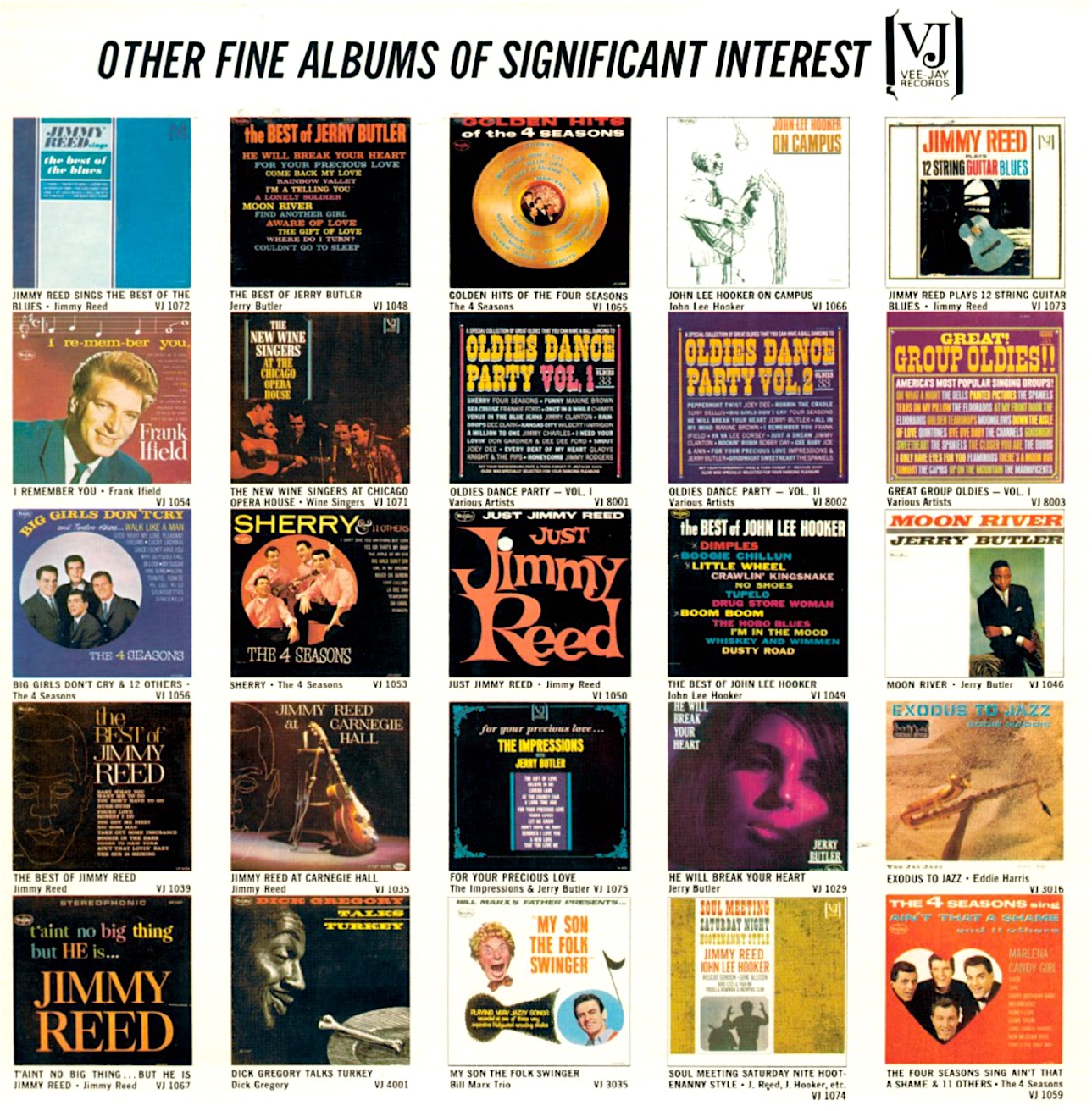
“Calvin did it for 12 years,” Jerry Butler later said, “and when you list the acts he signed, using no other ears to depend on but his own, it reads like a ‘who’s who’ in the music business. He covered every base. For example, gospel acts he signed: Five Blind Boys, the Staple Singers, the Swan Silvertones, Maceo Woods, the Raspberry Singers. In the blues field, he signed Jimmy Reed and John Lee Hooker. In R&B, the Dells, the Spaniels, myself, the El Dorados. Female singers such as Priscilla Bowman and Betty Everett. The jazz artists included Eddie Harris and the MJT+3.”
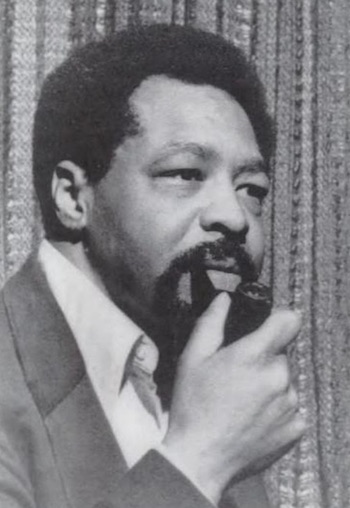
Like his sister Vivian, Calvin Carter [pictured] had a natural knack for promotion, and like Abner, he maintained an unblinking focus on the goals at hand, particularly in the role of A&R man.
“As soon as [Calvin Carter] thought he had a winner,” Butler said, “he started promoting it himself and didn’t stop until it was a hit.
“Unfortunately, the only industry people knowing him today are those who came in contact with him back in those days; but I think he deserves a place in R&B music on the same level as Phil Spector.”
Comparisons to Phil Spector don’t exactly mean what they used to, but you still get the point.
[Along with guiding Vee-Jay’s sound from behind the scenes, Calvin Carter also sometimes put himself on wax, including this obscure number from 1962]
III. Biggest Little Giant
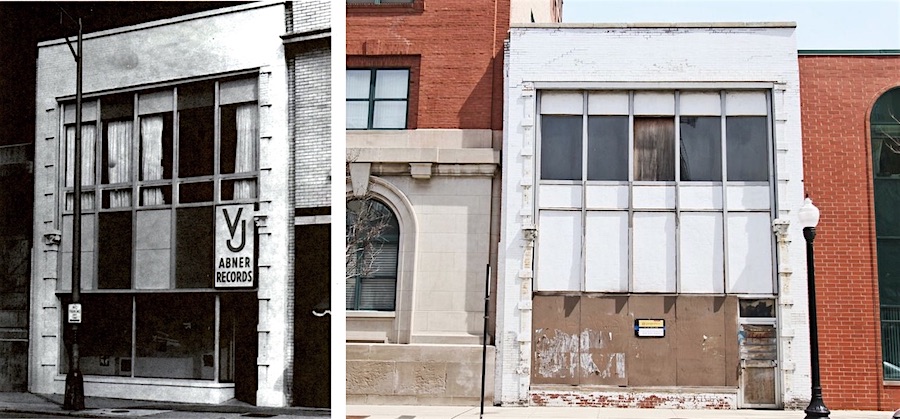
The Brackens moved the Vee-Jay HQ down the street to its more famous location, 1449 S. Michigan Ave., in 1960 (the same building would later house Brunswick Records from 1966 to 1976). By now, Vee-Jay was a big enough name that talent tended to seek them out, rather than the other way around.
[The Vee-Jay office building at 1449 S. Michigan, in 1961 and 2016]
In 1961, another one of Vee-Jay’s Michigan Avenue neighbors, the Johnson Publishing Company, made the label the focus of a feature article in the pages of Ebony magazine.
“Among America’s top record manufacturers—the men who know recordings best—Chicago’s hit making Vee-Jay Record Co. is fast becoming the biggest little giant in the industry,” the article claimed. “In a business known for its get-rich-quick luck and disappointing heartbreak, the Windy City firm now ranks tops among the 500 independent companies and has begun competing against the mighty chains who once controlled the market.”
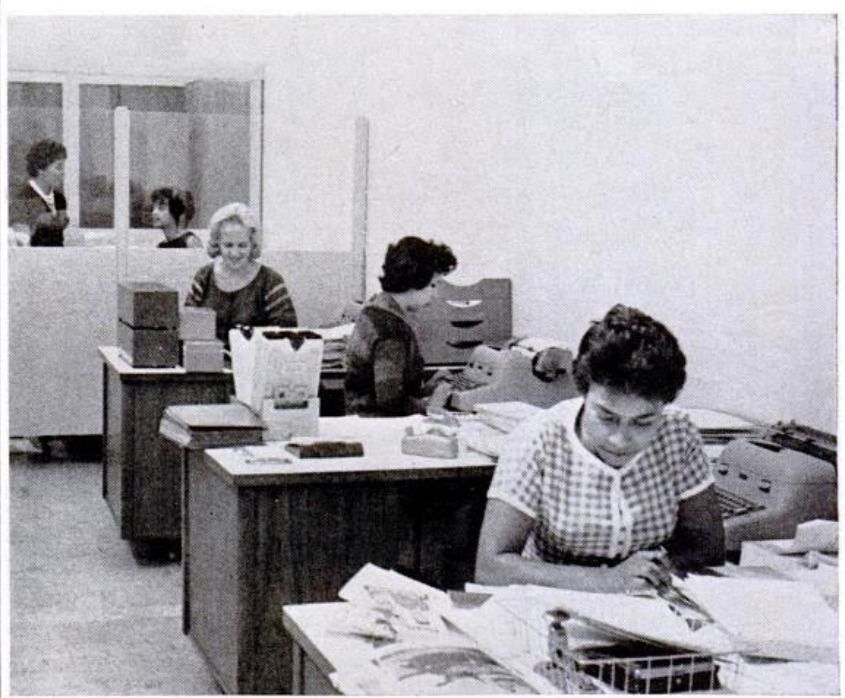
[Receptionists at the Vee-Jay offices in 1961. From left to right: Vera Watson, Charlotte Iwanaga Enright, Judy Snowden, Elena Morelieras, and Sharon Gamble. From Ebony magazine.]
Vee-Jay had a fairly small staff of 22 employees in 1961, but they were grossing $3 million annually—about $25 million after inflation—and clearly feeling cocky about it (best example: a 1961 release titled Jimmy Reed at Carnegie Hall, which was literally just a studio session of Reed playing inside a rented room in Carnegie Hall—there had been no live show).
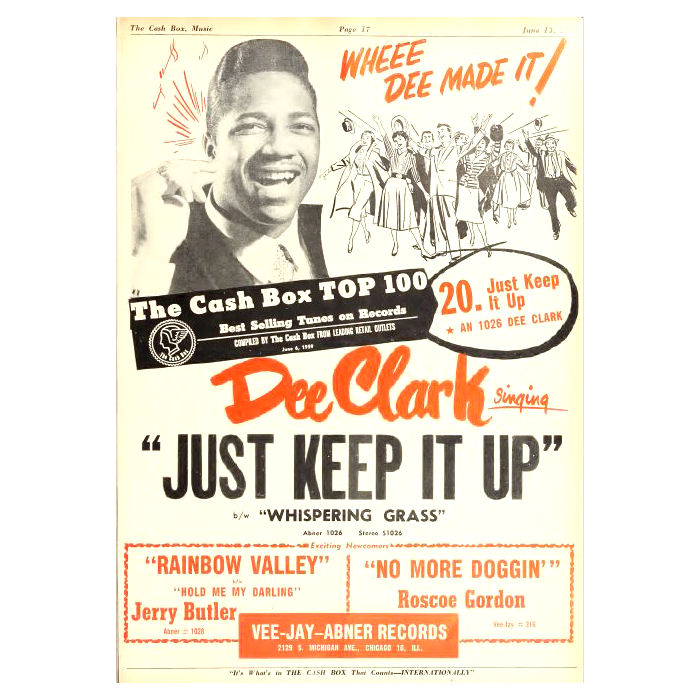
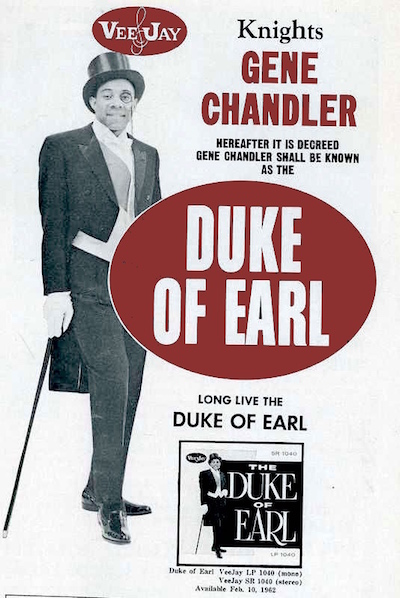
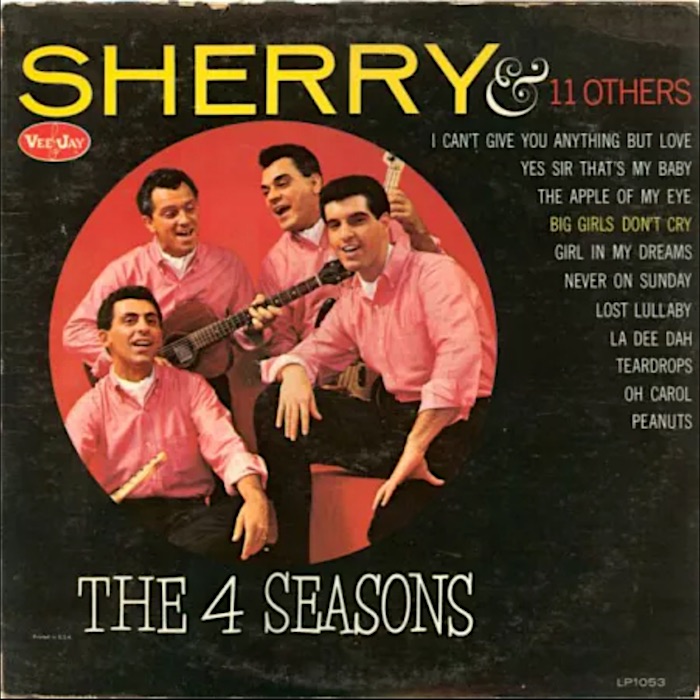
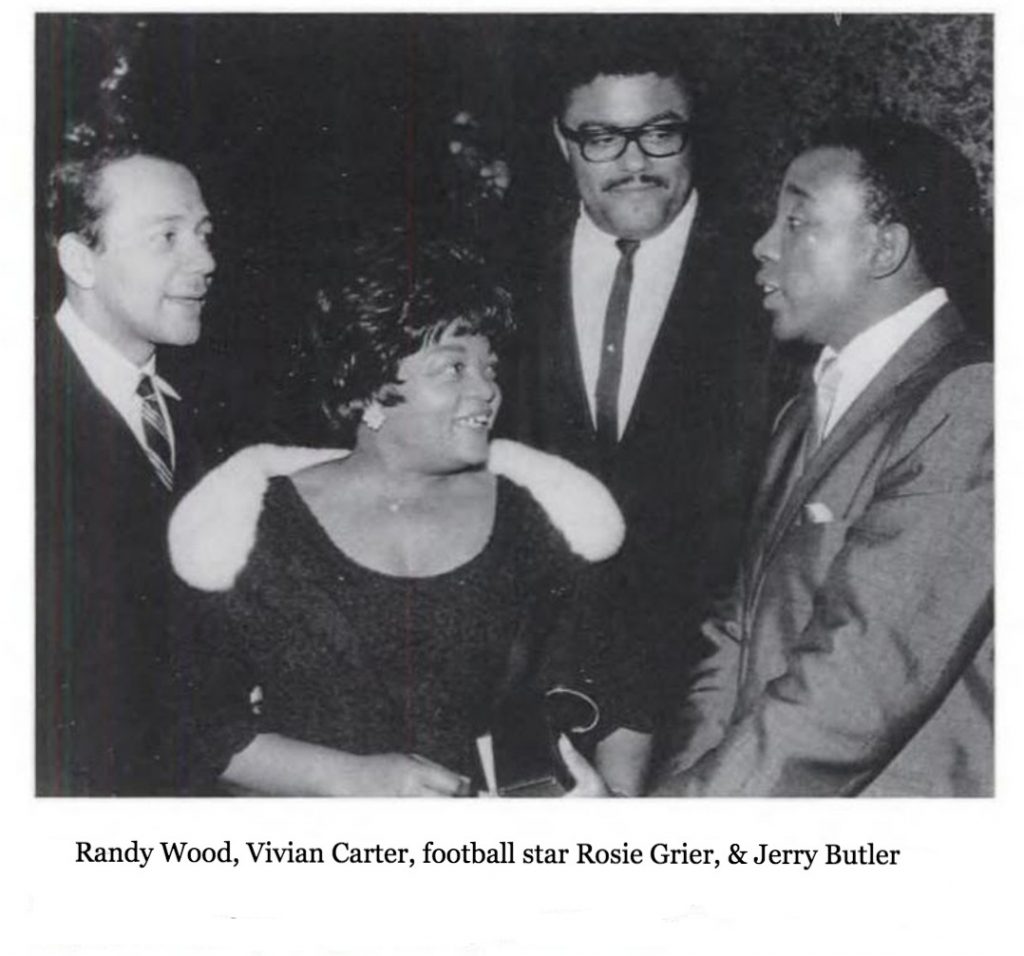
Heads only grew larger by the spring of ‘62, when Gene Chandler’s “Duke of Earl” became the label’s first million seller, soaring to No. 1 on the Billboard Hot 100 for three weeks. Later that summer, one of Ewart Abner’s great white hopes, a harmony group from New Jersey called the Four Seasons (discovered by a new Vee-Jay rep named Randy Wood), hit the No. 1 spot with their debut single, “Sherry.” Their next release, “Big Girls Don’t Cry,” promptly followed suit, turning the group into a sensation. In a truly groundbreaking development, the biggest white act in America was putting out its records on a black-owned label. Abner’s genius was confirmed, and observers as far away as London were taking note.
IV. Leading the Invasion
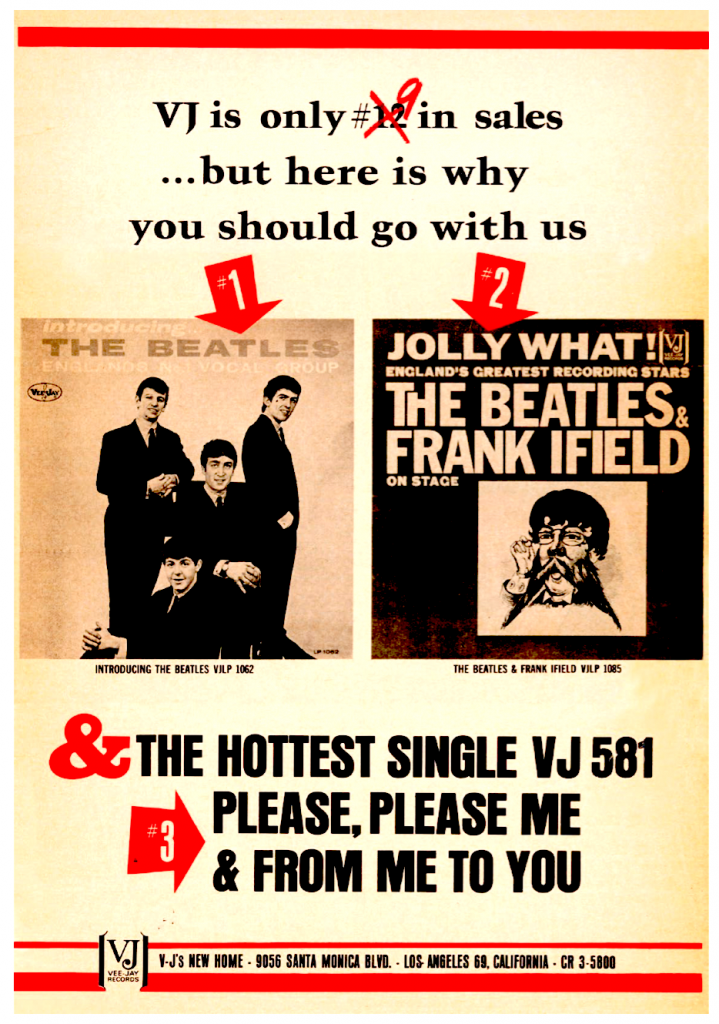
In the summer of ’62, at the same time the Four Seasons were exploding, a young British torch singer named Frank Ifield was enjoying a breakout No. 1 hit of his own—in his native UK, at least—with a cover of an old WWII tune, “I Remember You.” EMI owned the rights to the track overseas, but their U.S. subsidiary, Capitol, took a hard pass on releasing it in the States. So, as the fates would have it, EMI turned to that hot new label in Chicago—the one with the Four Seasons—to bring Frank Ifield stateside. Happily embracing another opportunity to expand its portfolio, Vee-Jay inked a licensing agreement to put out the record, and it did well, reaching No. 5 on the charts.
Subsequent Ifield records mostly fizzled out, but for Vee-Jay, the more important development was its new relationship with EMI, which positioned them as a viable destination for any additional British acts that Capitol—in its infinite wisdom—deemed unfit for the U.S. market. You can see where this is leading.
In January of 1963, Vee-Jay Records—with virtually no fanfare—agreed to a licensing agreement for a batch of recordings by a spunky Liverpool quartet called The Beatles. Vee-Jay’s chief international representative at the time was a 30 year-old woman named Barbara Gardner, who traveled to London to cut the deal. By the end of the decade, Gardner (by then known as Barbara Proctor) would become the first African-American woman to own and operate her own advertising agency.
In retrospect, the Beatles signing certainly looks like an incredibly fortuitous gamble for Vee-Jay, but the pay-off wasn’t as instantaneous as one might expect—nor did the label seem to realize just how big of a marlin they had actually managed to wrangle.
Case in point, when Vee-Jay released its first Beatles single, “Please Please Me,” in February of 1963, the initial pressings all misspelled the band’s name as BEATTLES, with a now infamous extra T tossed in. Perhaps still none the wiser, Ewart Abner handed the record to disc jockey Dick Biondi at Chicago’s WLS, who subsequently gave the Fab Four their first known radio airplay in America, a full year before the British Invasion effectively began. Radio listeners didn’t seem to dig the Beattles as much as they’d eventually love the Beatles, however, and the single topped out at #35 on WLS before disappearing. The follow-up, “From Me To You,” also made little impact, seemingly validating Capitol’s decision to pass on the Liverpudlians in the first place.
And then . . . everything began to change, not just for John, Paul, George and Ringo, but the Chicago label that had hitched itself to their rocketship. By the summer of ’63, Beatlemania had officially broken out in Britain—the screaming girls, the media storm, the whole nine yards. At the same time, Vee-Jay was beginning a year of turnover, tumult, and plot twists the likes of which most labels wouldn’t experience in a lifetime. It started with an announcement that “hit the industry with the force of an explosion,” according to Billboard magazine, as Ewart Abner was unceremoniously fired from his post as company president.
Vivian and Jimmy Bracken hadn’t exactly been conservative with their new wealth over the past couple years, but none of their lavish expenses could account for how much debt seemed to be mounting at the Vee-Jay offices. The true culprit, it seemed—to everyone’s despair—was Abner. His own high-roller lifestyle and a penchant for high stakes gambling had, according to many accounts, forced him to “borrow” from the company kitty—something in the neighborhood of $200,000. Far worse than that, the label had fallen into a slew of other holes, owing back taxes to the government, $250,000 in overdue bills to a single pressing plant alone, and most glaringly, a big chunk of royalty money to the Four Seasons—which had pushed the group to file a lawsuit.
With Abner ousted, Vivian and Jimmy installed Randy Wood as the new president, and his new management team—largely based in Los Angeles—took over 49% ownership of the business. Calvin Carter (who remained in Chicago) was a stockholder, too, but he began to clash with his L.A. partners right from the get-go, particularly when Wood pushed for the label to move its offices to the West Coast and focus more attention on its pop acts. Calvin, effectively representing his sister and brother-in-law, wanted Vee-Jay to get back to its Chicago roots. A civil war was essentially underway, and amid all that chaos, a crucial legal battle was brewing, as well.
[Beatlemania was in full swing in Britain throughout 1963, but in the States, this CBS News story from the morning of November 22 was many Americans’ introduction to the phenomenon. The report was due to re-air that night, but the assassination of JFK delayed the re-broadcast for weeks.]
V. Vee-Jay vs. Capitol
Just about the only thing everyone at Vee-Jay could agree on by the end of 1963 was that, in order to make money and pay their debts, they would need to get a Beatles LP out on the shelves ASAP. By now, Capitol Records had realized its earlier mistake and had acquired its own batch of Beatles songs from EMI, with an album slated for a January 1964 release. Beatlemania was hard-charging for the shores of the U.S., and Vee-Jay couldn’t possibly let it happen while sitting on a stack of unsold recordings.
Fortunately, Calvin Carter already had most of Introducing the Beatles in the bag and ready to go. Vee-Jay had actually planned on releasing it back in the summer of 1963, but the Abner firing and ensuing madness had put it on the back burner. Now, by throwing together packaging, pressing, distribution, etc., they could make up lost ground and beat Capitol to the punch.
Sure enough, the first version of Introducing arrived just before Capitol’s Meet the Beatles in January of ’64, and it became every bit the financial godsend that Vee-Jay had hoped for. Since Capitol experienced even greater sales with its record, you might think everyone could reap the rewards together in peaceful solidarity, basking in Beatlemania’s riches. But Goliath was not interested in being David’s friend.
Instead, Capitol filed suit (one of about 64 lawsuits Vee-Jay had pending at the time, according to Randy Wood), claiming that a failure to pay royalties had rendered all of Vee-Jay’s previous rights to the Beatles catalog null and void.
“We put the album out, and EMI, through Capitol, sued us to cease and desist,” Calvin Carter told Goldmine in 1981. “They got an injunction against us seemingly every week. They would get an injunction against us on Monday, and we would get it off on Friday, then we’d press over the weekend and ship on Monday; we were smooth, we had everybody alerted, and we were pressing records all the time on the weekends.”
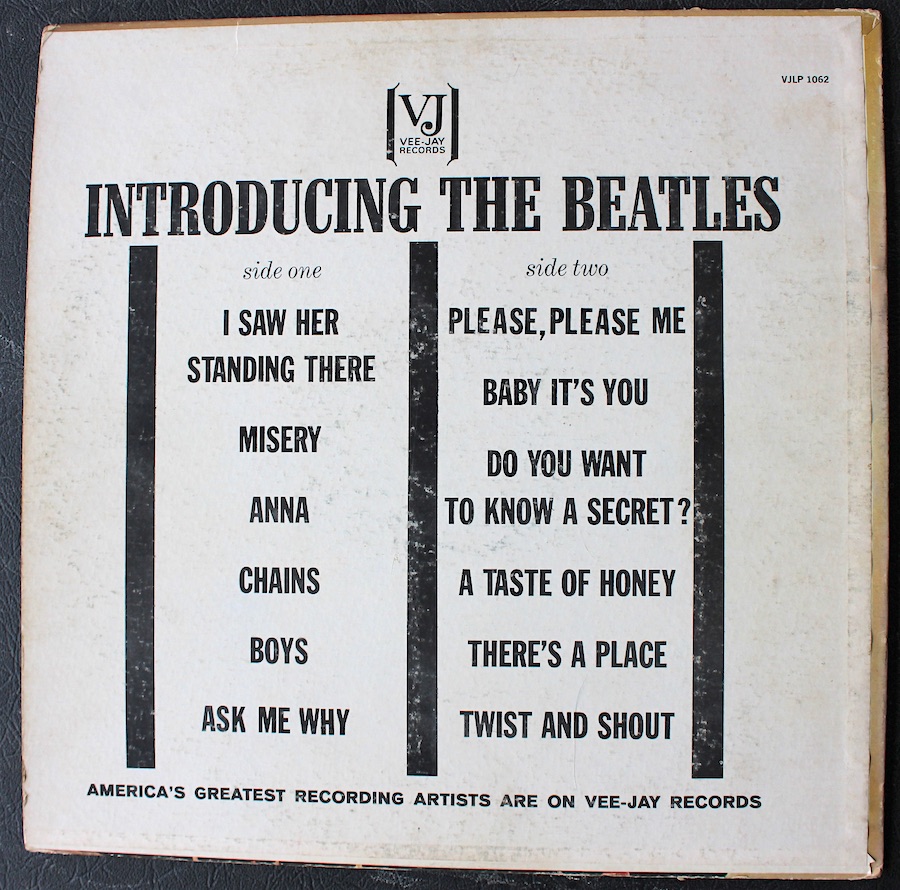
Even when a judge ordered Vee-Jay to cease any use of the songs “Love Me Do” and “P.S. I Love You” (both on Version 1 of Introducing), the battle was far from from over. Instead, through an admirable effort of focused desperation, Vee-Jay threw together Version 2 of the album, replacing the banned tracks with “Please Please Me” and “Ask Me Why.” A ramshackle new back cover came with it, revealing the updated track list in two plain columns.
The Version 2 album in our museum collection was likely pressed in February or March of 1964, and it was one of more than a million copies sold that year. Unfortunately, Vee-Jay’s ongoing legal fight was less fruitful, as they finally settled out of court in April, agreeing to pay royalties to Capitol on future sales.
“We finally made something out of the court settlement, because we just couldn’t afford to fight that big a company,” Calvin Carter said. “We kept what we had, and they had all future product. We were selling so many Beatles records, we just couldn’t afford to fight for the five-year rights. At that point, we had even got a ten-year moratorium from our creditors on our outstanding bills, that we’d just keep them coming. There was a lot of pressure on us. We sold in one month’s time about 2.6 million Beatles singles on Vee-Jay and Tollie [a subsidiary]. Those were fantastic times. And right in the middle of this, we moved from Chicago to California. What a mess, what a mess.”
[Randy Wood, who became Vee-Jay’s president in the wake of Ewart Abner’s firing, presents a gold record to John Lennon]
VI. The End Times
It’s a bittersweet tale if there ever was one. Just one month after releasing the first Beatles album in America, Vee-Jay abandoned Chicago for Santa Monica, and it would set the label on course toward its doom.
“We got the Beatles, and went from 15 or 20 employees to like 200 overnight,” Calvin Carter said. “The growth was just too fast. Everybody in there had a store of their own, there were lease cars all over the place, and it was just a bad job of managing. After we got the Beatles, they came up with a bright idea and all started trying to be grabbing stock. It was a Marx Brothers movie.”
Randy Wood was a fine record man in his own right, but his hopes of controlling the wobbling Vee-Jay behemoth from L.A. didn’t quite pan out. Some of the label’s top R&B acts had already left and signed with Ewart Abner’s new Constellation label, and the Four Seasons went to Mercury. The team in California did its damndest to sign new talent, stay profitable, and rearrange the deck chairs on the Titanic (including the creation of more subsidiary labels like Tollie, Interphon, and Oldies-45), but the creative feud with Calvin and the Brackens had never been resolved, and the company’s whole reputation was collapsing under the weight of the ongoing disconnect.
With no new Beatles material headed their way, Vee-Jay got embarrassingly creative in its efforts to squeeze every dime possible out of their mop-topped cash cow, too. They did several re-releases of the songs they already had, gussied up in new packaging, including bizarre combo albums with other acts that were marketed as faux collaborations—The Beatles & Frank Ifield On Stage (they weren’t together and the recordings weren’t live) and The Beatles vs. The Four Seasons. Maybe worst of all, there was VJ-1101: The 15 Greatest Songs of the Beatles— All composed by John, Paul and George . . . [fine print]and sung by the Merseyboys.”
Trying to trick young Beatles fans like my mom into buying some low-rent cover band’s record?! For shame.
[When is a Beatles record NOT a Beatles record? . . . When it’s sung by the Merseyboys]
Finally, a frustrated Jimmy Bracken had had enough of the nonsense. He swooped in and bought out the L.A. management group in 1965, re-installed Ewart Abner as general manager, and moved the Vee-Jay HQ back to Chicago. There was an exciting hope of putting everything back the way it was, and it seemed possible for a while. But there’s a reason people say “you can never go home again.” Not only was the company forever changed (and seemingly forever in debt), but the world was different, too. It was a rough crawl to the finish line.
Down to just a handful of artists, Vee-Jay officially closed its Chicago offices in May of 1966 and was liquidated by the end of the summer. The following year, the IRS even seized Vivian Carter’s record shop in Gary, which she had kept going through the entire Vee-Jay run. The Brackens’ fortune was effectively erased, and Vivian was left back where she started, hosting her radio show and playing records released by other labels.
Most of Vee-Jay’s assets were purchased after its bankruptcy (presumably for a song) by Randy Wood and another former company exec, Betty Chiappetta. This enabled the sale of the back catalog on a new imprint, Vee Jay International, in the late ‘60s and ‘70s, and also set the table for several re-launches of the brand in the decades that followed (to humble returns).
Clearly, it’s Vee Jay’s original run, from 1953 to 1966, that has held the attention of music historians. The label produced a treasure trove of great work (the vast majority of it recorded in Chicago at the Universal Recording Corp studio) that helped set the tone for the ‘60s music revolution. Sure, it might have turned into a “what if?” story in the end, but the what ifs would have been far more devastating without Vee-Jay’s contributions. Would we have still had the Impressions? Jimmy Reed? John Lee Hooker? The Staple Singers? The Four Seasons? . . . The Beatles?! . . . Okay, yeah, probably the Beatles. But nonetheless, respect.
[I suppose it’s 50 years too late at this point, but there really ought to be an apostrophe in “Englands”]


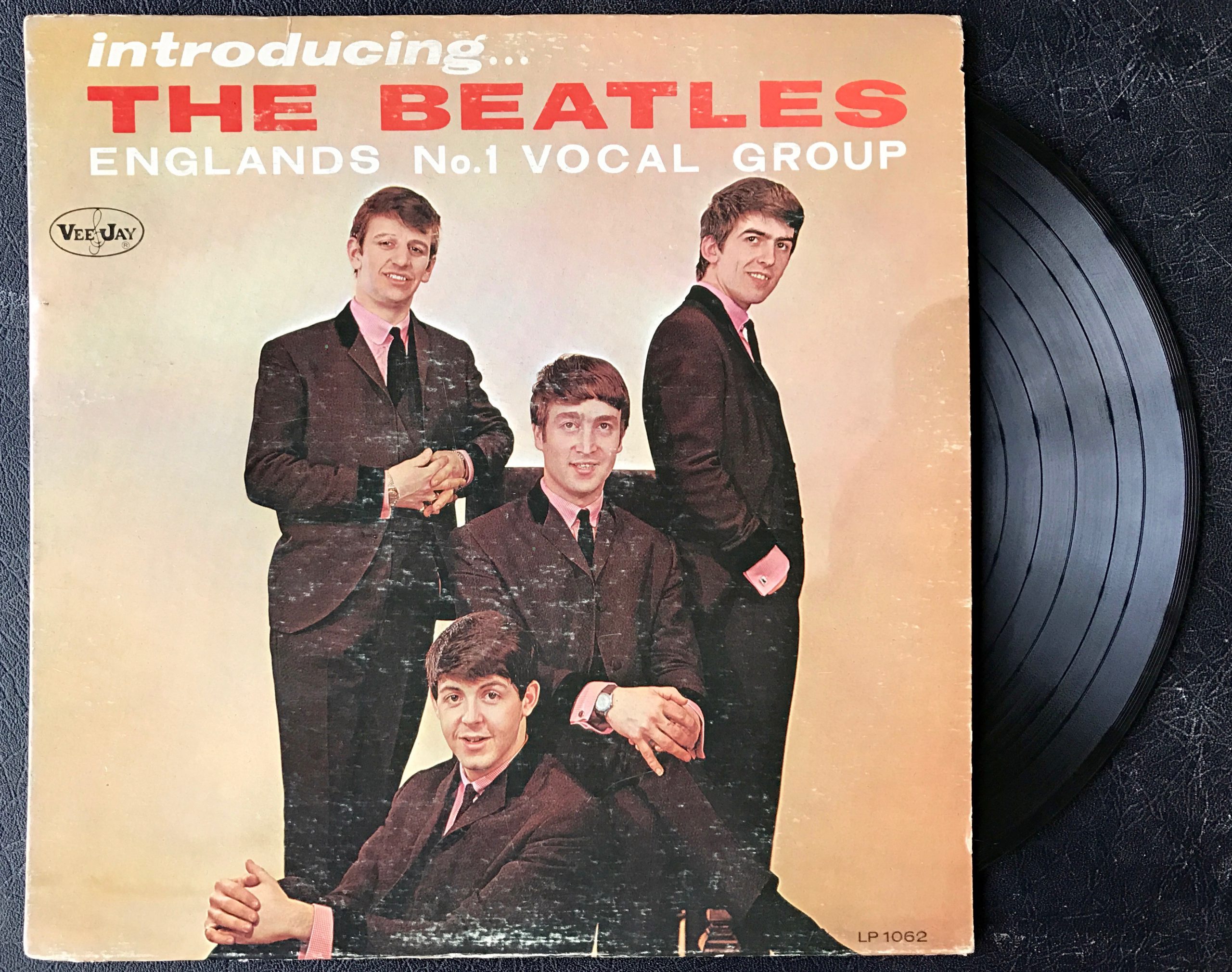
 Back in ’64, of course, young fans of the Liverpool lads didn’t care much about the business end of Beatlemania—labels and contract disputes, etc. They just wanted anything with John, Paul, George & Ringo on it. So, while Vee-Jay’s Introducing the Beatles has the distinction of being the first long-player Beatle album released in the U.S. (January 10, 1964), Capitol’s Meet the Beatles—released just two weeks later—immediately joined it at the top of the charts. Together, these records dropped the needle on a seismic pivot point in American culture, coming less than two months after the assassination of John F. Kennedy and one month before the Beatles themselves landed at the newly renamed JFK Airport in New York—recharging the batteries of a dazed populous in a bleak winter.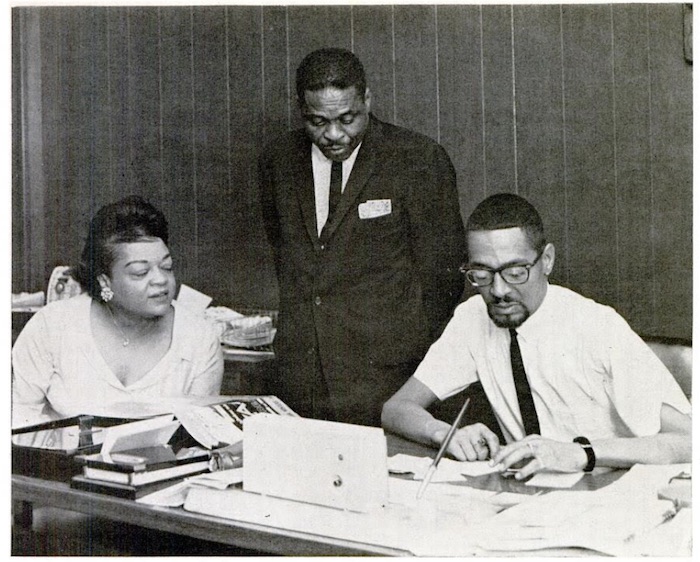
 In the half-century since Vee-Jay’s demise, historians have inadvertently—but continuously—simplified the label’s musical legacy into a sort of frustrating “also ran” category. In a Chicago context, its contributions to blues and R&B are overshadowed by its Michigan Avenue neighbor,
  For several years, Vivian learned all about the relationship between music and marketing. She could hear a new record at her shop and promote it on her show (which featured mostly gospel and a little rhythm & blues), or—in many cases—she’d get positive feedback about a song from her radio listeners, and use it as an impetus to try and stock the corresponding record at the store. The only snag was that many local acts simply didn’t have any recordings available outside of a demo. And so, the next logical step became crystal clear.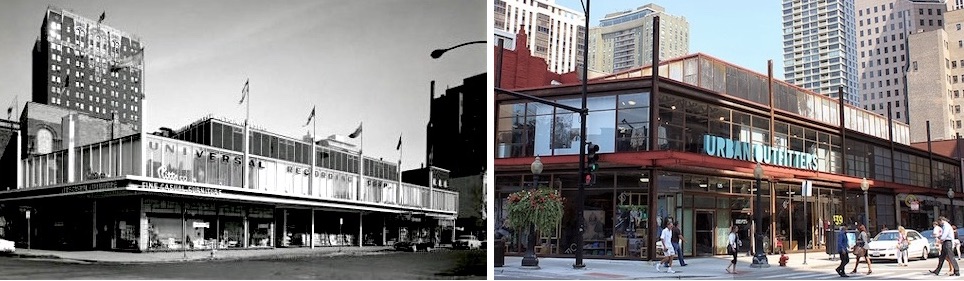
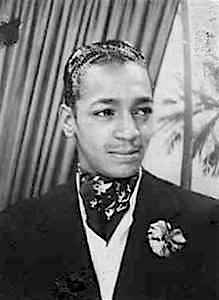 A graduate of Englewood High School and Howard University,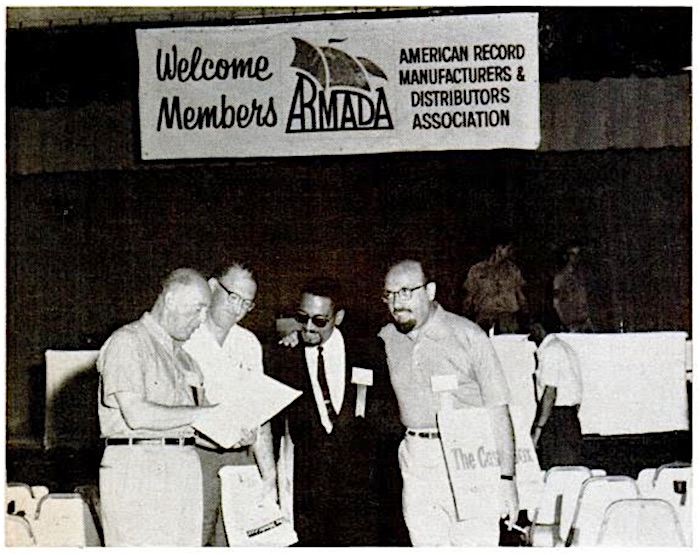
 Like his sister Vivian,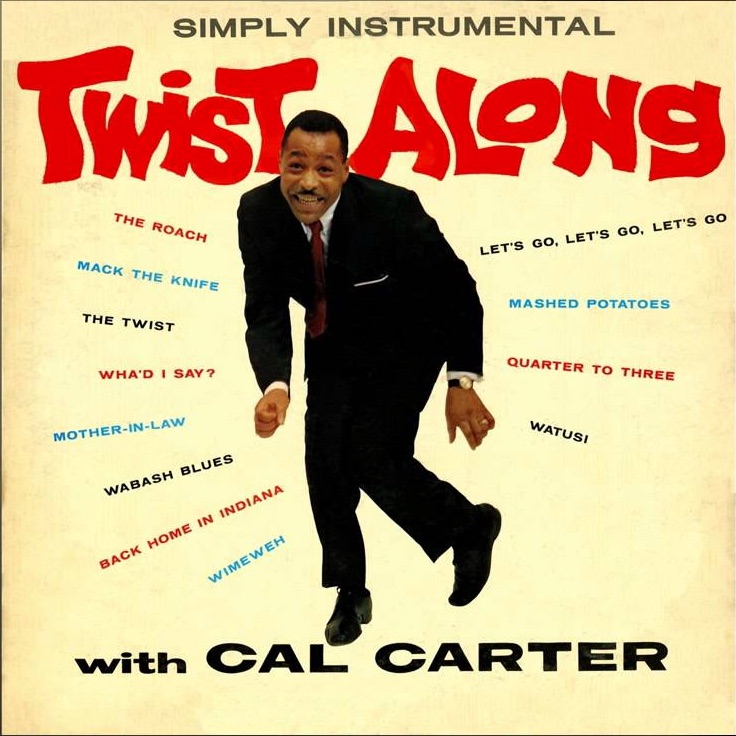
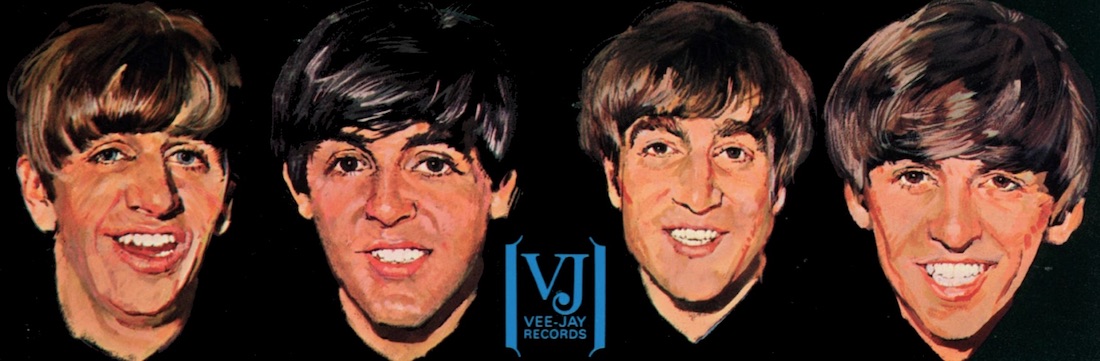
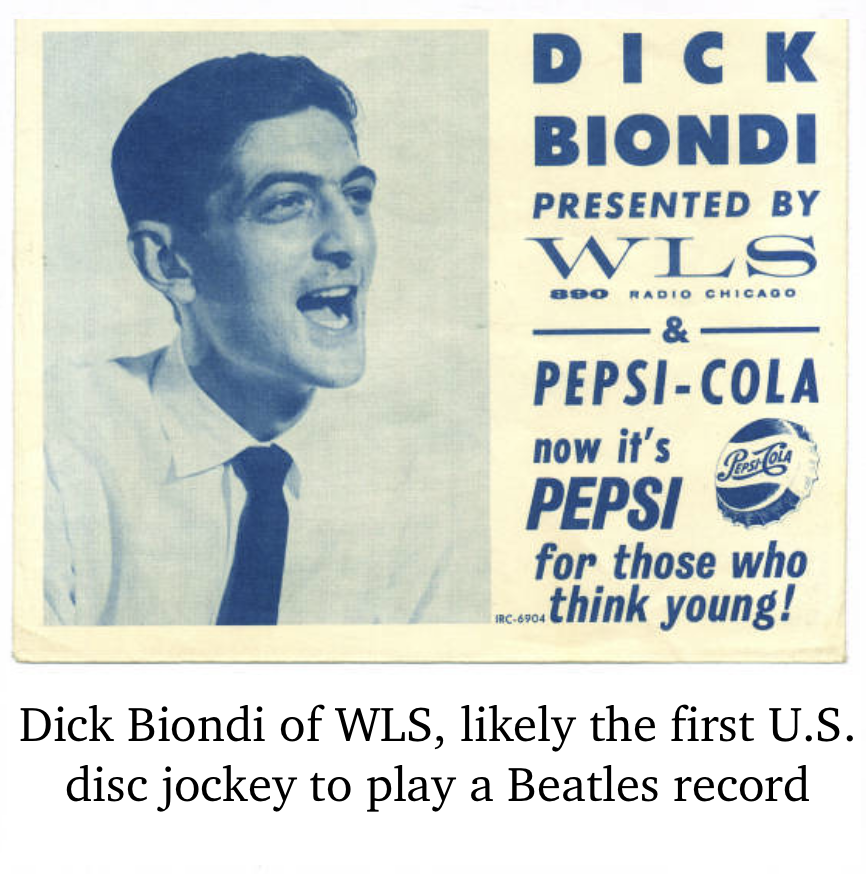 Case in point, when Vee-Jay released its first Beatles single, “Please Please Me,” in February of 1963, the initial pressings all misspelled the band’s name as BEATTLES, with a now infamous extra T tossed in. Perhaps still none the wiser, Ewart Abner handed the record to disc jockey Dick Biondi at Chicago’s WLS, who subsequently gave the Fab Four their first known radio airplay in America, a full year before the British Invasion effectively began. Radio listeners didn’t seem to dig the Beattles as much as they’d eventually love the Beatles, however, and the single topped out at #35 on WLS before disappearing. The follow-up, “From Me To You,” also made little impact, seemingly validating Capitol’s decision to pass on the Liverpudlians in the first place.
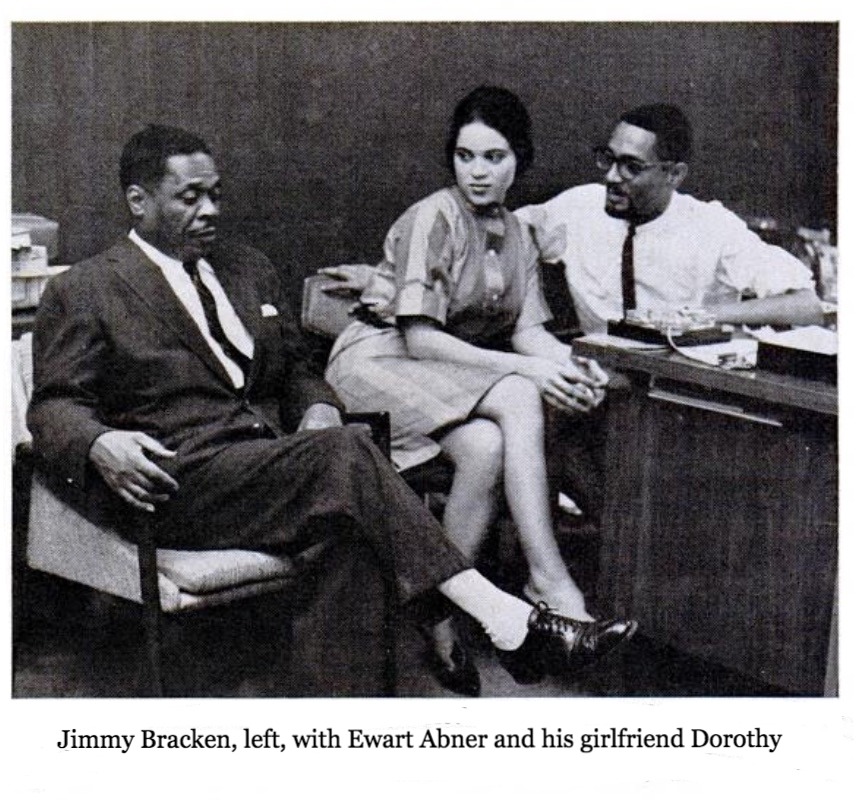 Vivian and Jimmy Bracken hadn’t exactly been conservative with their new wealth over the past couple years, but none of their lavish expenses could account for how much debt seemed to be mounting at the Vee-Jay offices. The true culprit, it seemed—to everyone’s despair—was Abner. His own high-roller lifestyle and a penchant for high stakes gambling had, according to many accounts, forced him to “borrow” from the company kitty—something in the neighborhood of $200,000. Far worse than that, the label had fallen into a slew of other holes, owing back taxes to the government, $250,000 in overdue bills to a single pressing plant alone, and most glaringly, a big chunk of royalty money to the Four Seasons—which had pushed the group to file a lawsuit.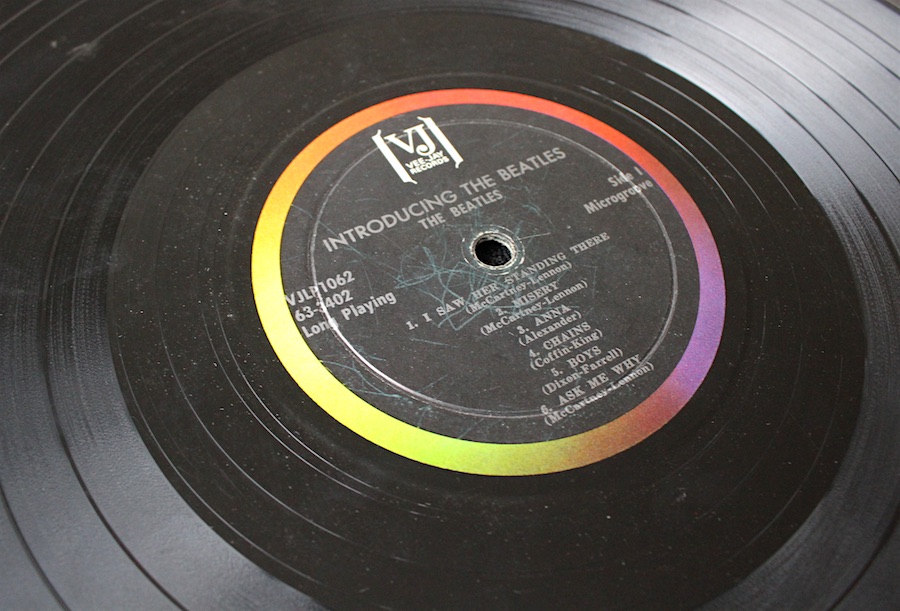
 “We put the album out, and EMI, through Capitol, sued us to cease and desist,” Calvin Carter told Goldmine in 1981. “They got an injunction against us seemingly every week. They would get an injunction against us on Monday, and we would get it off on Friday, then we’d press over the weekend and ship on Monday; we were smooth, we had everybody alerted, and we were pressing records all the time on the weekends.”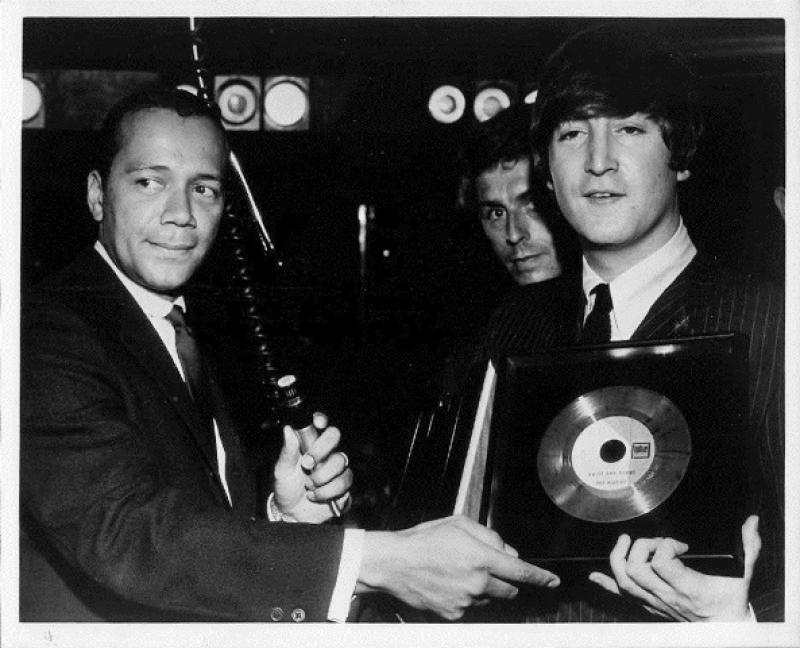
 Randy Wood was a fine record man in his own right, but his hopes of controlling the wobbling Vee-Jay behemoth from L.A. didn’t quite pan out. Some of the label’s top R&B acts had already left and signed with Ewart Abner’s new Constellation label, and the Four Seasons went to Mercury. The team in California did its damndest to sign new talent, stay profitable, and rearrange the deck chairs on the Titanic (including the creation of more subsidiary labels like Tollie, Interphon, and Oldies-45), but the creative feud with Calvin and the Brackens had never been resolved, and the company’s whole reputation was collapsing under the weight of the ongoing disconnect.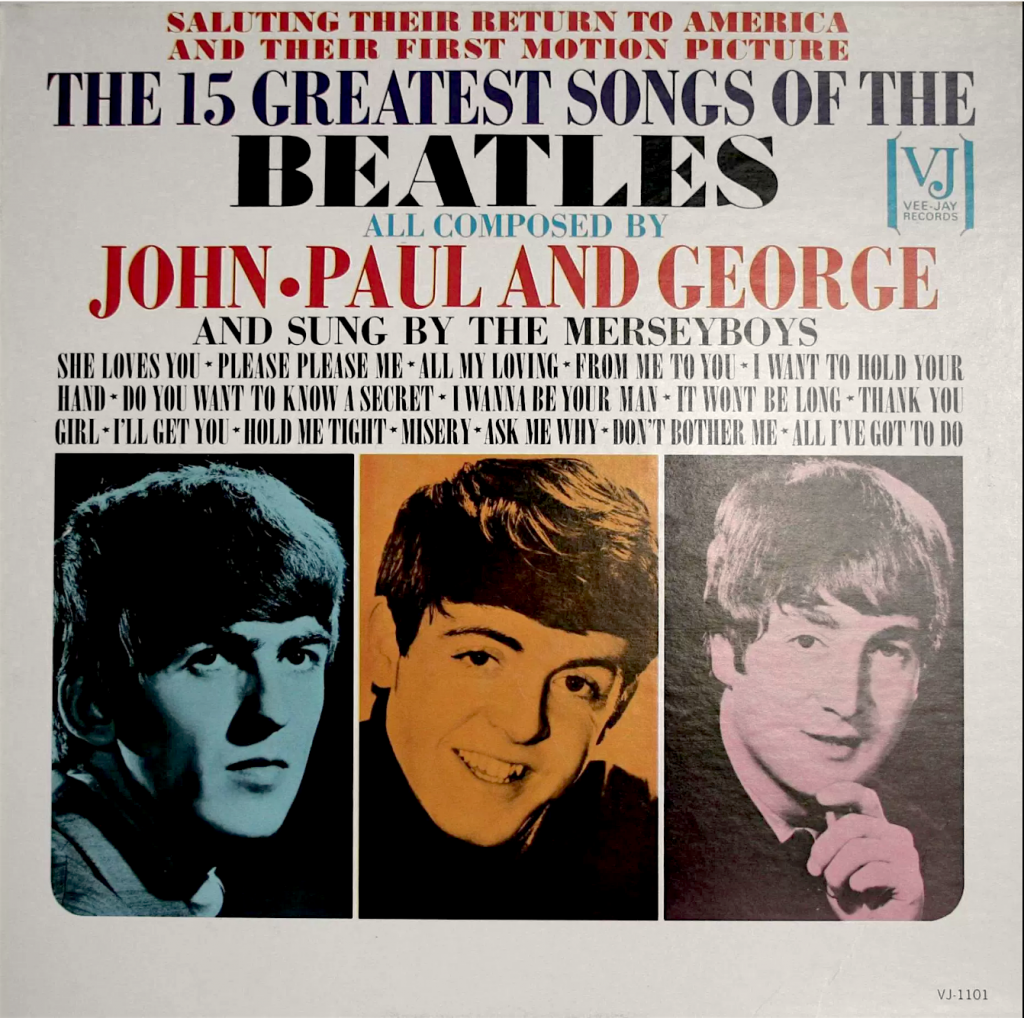
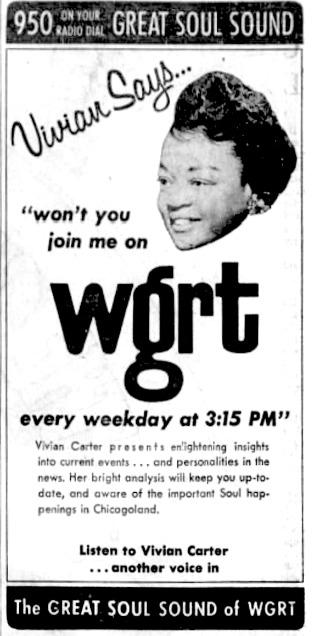 Down to just a handful of artists, Vee-Jay officially closed its Chicago offices in May of 1966 and was liquidated by the end of the summer. The following year, the IRS even seized Vivian Carter’s record shop in Gary, which she had kept going through the entire Vee-Jay run. The Brackens’ fortune was effectively erased, and Vivian was left back where she started, hosting her radio show and playing records released by other labels.